
Sales Funnel Design
Why Sales Funnels Matter for Your Business
A funnel is the journey your ideal customer takes from discovering what you offer to buying (and buying again). That makes it the tool that lets you attract, persuade and sell in a predictable, scalable way.
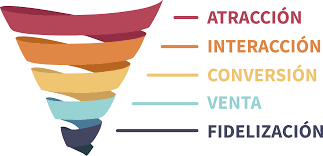

Sales Funnels Built for Small Businesses, Freelancers and Large Companies
- Sales funnels for small businesses: they professionalise lead generation so you don’t rely on word of mouth alone.
- Freelancers and the self-employed: they let you sell products or services quickly and simply with limited resources.
- Larger companies: they align marketing and sales, measuring every stage to scale results.
Remember, a professional sales funnel is the most solid way to grow through strategy rather than luck. With the right landing page, the right tools and a design built to convert, you’ll turn every visit into a loyal customer.
How to Build a Professional Sales Funnel, Step by Step
Wondering what a sales funnel is and why every business that sells online talks about them? A sales funnel is the system that guides your ideal customer from discovering your brand to finally buying and becoming a repeat customer. It’s not just theory: done properly, it’s the difference between visitors who do nothing (AND WE DON’T WANT THAT) and a steady stream of customers ready to buy.
How to build a sales funnel step by step
- An optimised landing page: it all starts with a page designed specifically to grab attention. Not a generic website, but a professional landing page optimised with digital marketing, persuasive copywriting and SEO.
- Lead capture: offer something valuable (an ebook, a discount, a demo) in exchange for the visitor’s contact details.
- Nurturing and trust: use emails and automation to educate, answer objections and build authority.
- A clear offer and action: present your product or service with an irresistible proposition and a direct call to action.
- Conversion and loyalty: after the purchase, nurture the relationship to win repeat sales and referrals.
Tools for Building Sales Funnels
Lots of people look for tools to build sales funnels. At Alex Multimedia we work with:
- WordPress: fast and flexible for launching and optimising landing pages and agile funnels.
- Drupal: robust and scalable when you need more complex, multi-site structures.
- Laravel: our own bespoke backend when a project needs specific functionality.
Sales Funnels: Frequently Asked Questions
It’s the journey your ideal customer takes from discovering you to buying and buying again, designed to attract, persuade and sell predictably.
For small businesses that want to win customers without relying only on referrals, for freelancers selling with limited resources and for companies that want to measure every stage of the sale.
WordPress for agile funnels, Drupal for complex structures and Laravel when a bespoke backend is needed.
A clear offer. We create the landing page, the lead capture system and the follow-up automation.
Yes. We can build the landing pages, lead magnets and follow-up emails in English, or in several languages if you sell to both international and local customers. The whole project is run in English, from the strategy session to the analytics reports, and we already work with clients outside Spain, including in the United States.
It depends on how many steps and automations the funnel needs, and on how ready your offer and content are. We give you a fixed timeline in the proposal once we’ve reviewed your project, so you know when it’ll go live before we start.
Not necessarily. A funnel can be fed by SEO, social media, email or referrals. Google Ads is often the fastest way to send qualified traffic and test the funnel, though, so we usually recommend a small campaign at the start to measure conversions and refine the funnel quickly.
We connect the funnel to the tools you already use, or recommend some if you’re starting from scratch. For automation we work with platforms such as Make and n8n, which let us link forms, email, CRM and payments so leads are followed up automatically and nothing falls through the cracks.
It has to be, and we build it that way: clear consent checkboxes on forms, a privacy policy that explains how data is used, a cookie banner and the option to unsubscribe from every email. Collecting leads without consent is one of the most common mistakes, and it’s easy to avoid from day one.
Last updated: